
I want to tell you about two people.
The first is a new assistant professor at a research university. She completed her PhD, did a postdoc, spent years building toward an independent lab. She has good ideas, strong mentors, and a research program with real promise. She is now applying for her first R01. She is also, for the first time in her career, seriously considering whether academic science is a viable long-term path.
The second is a graduate student in his third year. He is talented, motivated, and has a clear scientific vision. He also knows that to be competitive for faculty positions, he needs two or three first-author publications. He is watching the funding landscape and doing the math. Industry offers are arriving. The calculus is changing.
These aren't hypothetical people. They are composites of conversations happening in departments across this country right now. And the decisions they are moving toward represent one of the most serious long-term threats to the cancer research enterprise.
Two Categories of Risk
When we talk about early-career investigators, it's important to be specific, because the interventions look different depending on where someone is in their training.
New faculty are the most immediately visible category of risk. They are applying for first grants in a funding environment that is more competitive than it has been in decades. The NIH payline, the score threshold for funding, has been tightening for years. When federal budgets contract further, even well-scored applications go unfunded. For a new PI, a failed first R01 doesn't just mean a setback. It can mean the difference between keeping a lab open and closing it.
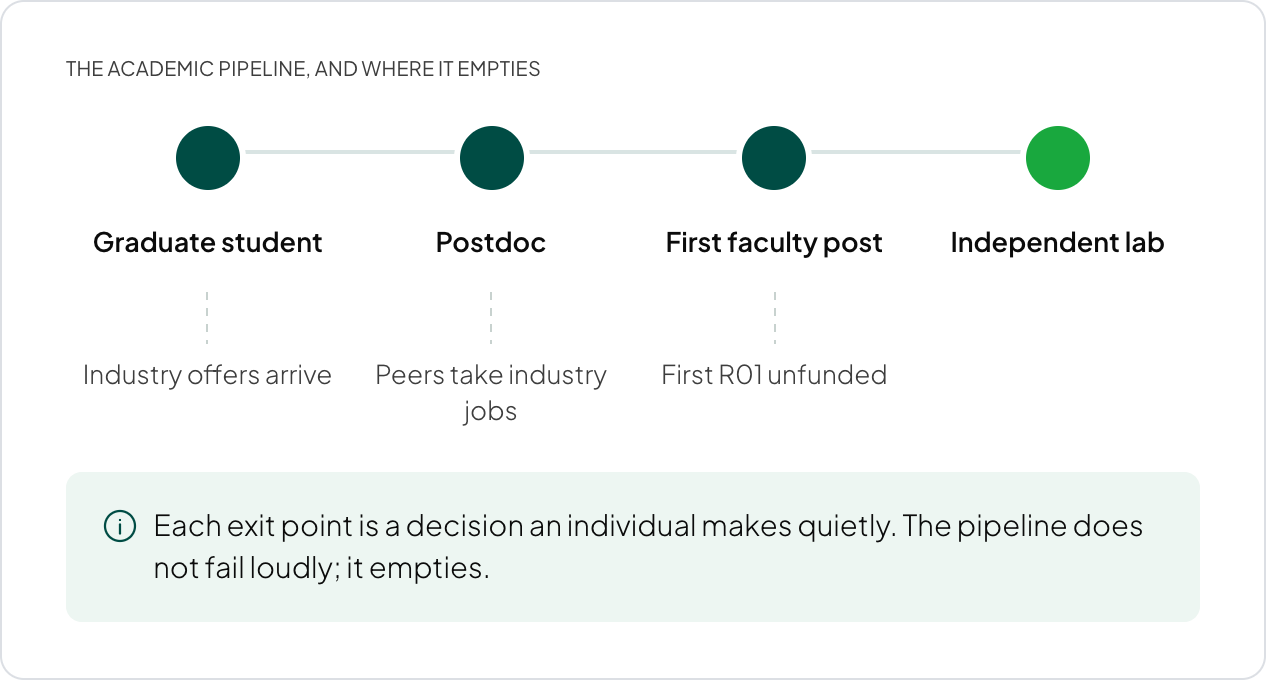
Trainees, graduate students and postdocs, face a different but equally serious risk. Their career decisions are shaped by what they observe happening to the people just ahead of them. If the assistant professors they admire are struggling to get funded, if the postdocs finishing ahead of them are taking industry jobs, they update their priorities. The academic career pipeline doesn't fail loudly. It empties gradually, as each cohort does the math and adjusts its expectations.